

Quick Answer: What Makes Affiliate Marketing Sustainable?
A sustainable affiliate marketing business is built around a clearly defined audience, useful evergreen content, multiple traffic sources, trusted recommendations, and diversified affiliate programs. Instead of chasing short-term trends, it solves real reader problems, maintains successful content over time, and creates publishing assets that can continue attracting qualified visitors and revenue.
Affiliate marketing is often presented as one of the simplest ways to make money online. Join an affiliate program. Get a tracking link. Publish content. Collect commissions. Technically, that describes the basic process. It does not describe how to build an affiliate business that survives.
Thousands of affiliate websites are created around trending products, temporary promotions, social media traffic, or a single affiliate program. Some generate money quickly. Many disappear just as quickly when rankings change, commissions are reduced, products disappear, accounts are closed, or readers stop trusting thin promotional content.
A sustainable affiliate marketing business works differently. Instead of treating affiliate marketing as a collection of links, successful publishers treat it as a publishing and recommendation business. They build useful resources around problems people are already trying to solve, develop topical authority, attract visitors from multiple sources, recommend relevant products, disclose commercial relationships clearly, and continuously improve the content that generates traffic and revenue.
That distinction matters because the affiliate link itself has almost no lasting value. The audience does. The content does. Search visibility does. Reputation does. An email list does. The body of useful information you build over time does. Those are the assets that turn affiliate marketing from a promotional tactic into an actual online business.
What Is Sustainable Affiliate Marketing?
Sustainable affiliate marketing is the practice of building long-term revenue by publishing useful content that connects an audience with relevant products or services while developing traffic, trust, and owned digital assets.
The central idea is simple: do not build your business around an affiliate program. Build your business around an audience.
Affiliate programs can change commission rates, tracking periods, policies, eligibility requirements, and product inventories. A website that exists solely because one merchant pays a particular commission is vulnerable. A website built around helping people solve a specific set of problems can change merchants whenever necessary.
Imagine one site that exists almost entirely to promote a single outdoor equipment retailer and another that teaches people how to choose camping equipment, prepare for backcountry trips, compare shelters, maintain gear, plan meals, select clothing, and solve common outdoor problems. Both may earn affiliate commissions, but the second website owns something more valuable than links. It owns a body of useful information and an audience interested in a defined subject.
If one merchant disappears, another can replace it.
How Does Affiliate Marketing Actually Make Money?
Affiliate marketing generally works through performance-based referrals. A publisher recommends or references a product or service and provides a trackable link. When a visitor follows that link and completes an eligible action, the affiliate may earn a commission.
Depending on the program, compensation may be based on completed purchases, qualified leads, subscriptions, software trials, account registrations, or other predefined customer actions. The exact compensation model varies considerably.
Affiliate marketers therefore need to look beyond the advertised commission rate. A lower commission attached to a trusted merchant with good conversion rates may generate more revenue than a larger commission attached to an unfamiliar product that few visitors purchase.
For a more basic overview of the model, see What Is Affiliate Marketing? and Affiliate Marketing: A True Win-Win Business Model.
Start With a Market, Not a Product
One of the most common affiliate marketing mistakes is choosing a product first and then trying to invent an audience for it. Reverse the process. Choose a market containing persistent questions, problems, hobbies, purchases, or recurring needs.
Strong affiliate markets usually share several characteristics. People actively research before buying. There are multiple merchants or products available. The market contains enough complexity to support useful educational content. New questions continue to appear. Customers purchase more than once or buy related products over time.
Examples include outdoor recreation, home improvement, business software, hobbies, photography, pet ownership, automotive maintenance, gardening, travel equipment, education, and many other categories.
The objective is not necessarily to find a market nobody has discovered. The better objective is to develop a useful publishing angle within a market where people already spend money.
Build Around Problems People Actually Have
Successful affiliate content typically begins with a question: Which product should I buy? What size do I need? Is this product worth the price? What is the difference between two options? What equipment do beginners need? How do I solve this problem? What should I avoid? What works best for a particular situation?
These questions reveal purchase intent. A visitor searching for “camping gear” could be researching almost anything. A visitor searching for “best sleeping bag for cold-weather car camping” has a much clearer need.
Specific questions usually create better content opportunities because the writer can provide a more precise answer. They are also useful for answer engine optimization because search engines and AI-powered answer systems often retrieve passages that clearly answer specific questions.
Build a Content Ecosystem Instead of Isolated Articles
An affiliate website becomes more valuable when individual pages support one another. Suppose you operate a site about home coffee equipment. Instead of publishing one article called “Best Coffee Makers,” you could build an entire subject cluster covering how different coffee makers work, drip versus pour-over coffee, choosing a grinder, burr versus blade grinders, coffee-to-water ratios, beginner brewing techniques, coffee maker maintenance, common brewing mistakes, coffee makers for small kitchens, and grinders for beginners.
Some pages have direct commercial intent. Others are purely educational. Together they establish topical depth.
Educational articles can introduce visitors to the subject. Comparison pages can help them narrow choices. Product-specific guides can answer final purchasing questions. Internal links connect those stages and create a stronger website than dozens of unrelated promotional posts.
The Four Main Types of Affiliate Content
1. Educational Content
Educational articles answer questions without requiring an immediate purchase. Examples include “How Does a Pellet Grill Work?”, “How Often Should Hiking Boots Be Replaced?”, or “What Does CRM Software Actually Do?” These articles can attract visitors early in the buying process and demonstrate genuine expertise.
2. Comparison Content
Comparison pages help readers understand differences between products, services, methods, or categories. Good comparisons explain who each option suits rather than artificially declaring everything a winner.
3. Buyer Guides
Buyer guides address visitors who know they need something but have not selected a specific product. They can generate strong commercial traffic because readers are actively evaluating purchases.
4. Product-Specific Content
This includes reviews, setup guides, tutorials, troubleshooting articles, accessories, compatibility information, and product alternatives. Product-specific content can perform especially well when it answers questions manufacturers or retailers overlook.
Search Intent Matters More Than Search Volume
Affiliate marketers often become obsessed with keyword volume. That can be misleading. A keyword receiving thousands of searches may have little purchasing intent, while a smaller query may represent a person much closer to making a decision.
Consider the difference between “running shoes” and “best trail running shoes for rocky terrain.” The first phrase describes an enormous category. The second describes a specific need.
Strong affiliate content should evaluate keywords according to intent, relevance, competition, and usefulness, not volume alone.
Evergreen Content Is the Foundation of Long-Term Affiliate Traffic
Evergreen content remains useful long after publication. Examples include “How to Choose a Camping Stove,” “How to Maintain a Chainsaw,” “How Affiliate Tracking Works,” “Beginner's Guide to Email Marketing,” and “Common Mistakes When Buying Used Tools.”
These topics are fundamentally different from temporary promotional content such as “Best Black Friday Deals This Weekend.” Deal content can produce revenue, but its useful lifespan is short. Evergreen pages can attract visitors for years when they are maintained.
A practical publishing strategy can use evergreen content as the foundation while adding seasonal or timely pieces when they genuinely serve readers.
Update Old Affiliate Content Instead of Constantly Publishing New Pages
An affiliate site does not necessarily become stronger simply because it contains more pages. Older pages can lose value when they contain discontinued products, expired promotions, broken affiliate links, outdated screenshots, old prices, obsolete recommendations, inaccurate specifications, or links to companies that no longer operate.
Routine content maintenance is therefore part of affiliate marketing. Review important pages periodically. Verify products. Test links. Replace discontinued recommendations. Improve explanations. Add newly relevant questions. Remove unsupported claims. Strengthen internal links.
Updating a good article can sometimes be more valuable than publishing another mediocre one.
Never Depend on One Affiliate Program
One merchant can change an entire affiliate business overnight. Programs may reduce commissions, terminate categories, close affiliate accounts, change attribution periods, discontinue products, or leave affiliate networks altogether. Publishers have little control over these decisions.
Merchant diversification should be considered a form of risk management. Whenever practical, build relationships with several compatible merchants. You do not need to place every merchant on every page. The objective is to ensure that your website remains viable if one relationship changes.
Diversify Traffic Too
The same principle applies to traffic. A website receiving nearly all its visitors from one source is vulnerable.
Search engines remain extremely valuable, but they should not necessarily be the only source of audience development. Depending on the niche, traffic can come from organic search, email newsletters, direct visitors, social platforms, YouTube, online communities, referral links, industry publications, podcasts, partnerships, and returning readers.
The strongest source will vary by business. What matters is reducing unnecessary dependence on a single platform.
Build an Email List Early
Search traffic is borrowed attention. Social media traffic is borrowed attention. An email list is closer to an owned audience.
Subscribers who voluntarily ask to hear from you can return repeatedly without rediscovering your website through a search engine or social platform. That makes email particularly useful for affiliate publishers.
A newsletter can distribute new educational articles, buying guides, updated comparisons, seasonal recommendations, industry news, tutorials, and product discoveries. The objective should not be to bombard subscribers with affiliate offers. Provide useful information consistently, then introduce relevant commercial recommendations where they naturally fit.
AffiliateCountry already covers this principle in Building a Power List of Subscribers to Earn Money Online Over and Over Again.
Trust Is the Real Conversion Tool
Affiliate publishers sometimes focus heavily on button placement, call-to-action wording, and conversion optimization. Those things matter. Trust matters more.
People buy through affiliate links when they believe the publisher is helping them make a good decision. That means an article should be willing to say a product is not suitable for everyone, a cheaper option may be sufficient, a feature may not justify the additional cost, a product has an obvious limitation, or a reader may not need to buy anything at all.
Counterintuitively, telling someone not to buy something can strengthen an affiliate business. Readers recognize when every article exists solely to force a transaction. Credibility compounds over time.
Affiliate Disclosures Should Be Clear
Affiliate relationships should be disclosed clearly and near the recommendation or commercial content they relate to. Site-level disclosure pages are useful, but readers should not have to hunt through a website to understand that a publisher may earn money from a recommendation.
AffiliateCountry maintains a dedicated Affiliate Disclosure, and commercial articles should continue to make the relationship apparent within the article itself.
Transparency is not merely a compliance concern. It also helps establish credibility with readers.
Do Not Publish Fake Reviews
Affiliate websites sometimes use the word “review” for products the publisher has never used or meaningfully evaluated. That weakens trust and can create regulatory problems when the language implies personal experience that did not occur.
If you personally tested a product, explain how. If you did not test it, do not imply that you did. You can still produce useful content through documented research, specification analysis, comparison, manufacturer documentation, user feedback, and other publicly available evidence. Simply describe the methodology accurately.
Avoid Fake Ratings and Manufactured Consensus
A rating such as “9.8/10” looks authoritative, but it means very little if the scoring system is not defined. The same applies to statements such as “everyone loves this product” or “the internet agrees.” Those claims are too broad unless supported by credible evidence.
A more trustworthy affiliate site explains what evidence supports its conclusions, where information came from, and what limitations remain.
GEO: Write So Information Can Be Retrieved and Cited
Generative engine optimization, or GEO, involves making content understandable and useful to AI-powered retrieval and answer systems. This does not require writing robotic articles. It generally requires writing clearer ones.
Useful GEO practices include descriptive headings, direct answers to important questions, clear definitions, context before recommendations, specific language instead of vague marketing phrases, authoritative sourcing for factual claims, separation of fact from opinion, logical grouping of related information, and transparent methodology.
Instead of writing “This is definitely one of the greatest affiliate strategies ever,” write something specific and retrievable, such as “Evergreen educational content can continue attracting relevant visitors after publication because the underlying question remains useful over time.”
AEO: Answer the Question Before Expanding the Explanation
Answer engine optimization, or AEO, structures information so a reader or answer system can quickly identify a clear response to a specific question.
For example, if the question is “How much money can affiliate marketers make?”, a useful direct answer is: Affiliate income varies widely and is not guaranteed. Earnings depend on audience size, traffic quality, niche, commission structure, conversion rates, merchant performance, and the publisher's ability to consistently attract relevant visitors.
That answer can stand independently. The article can then explain each factor in greater depth. This structure helps readers scanning the page and makes important passages easier to interpret.
SEO Still Matters
SEO remains one of the most valuable traffic channels for affiliate publishers because people frequently search immediately before making purchasing decisions.
Strong affiliate SEO usually includes clear site architecture, descriptive titles, logical headings, fast pages, mobile usability, relevant internal links, original content, strong topical coverage, useful images, accurate product information, updated pages, and transparent author and editorial information.
Search optimization should support the article rather than dominate it. A page written entirely for keywords rarely creates the trust necessary for strong affiliate conversions.
Build Topic Clusters
Instead of publishing randomly, organize your site around subject clusters. An affiliate marketing cluster might include: What Is Affiliate Marketing? How Affiliate Links Work. How Affiliate Cookies Work. How to Choose Affiliate Programs. Affiliate Marketing Disclosure Requirements. Affiliate Marketing SEO. Affiliate Content Strategy. Affiliate Email Marketing. How to Track Affiliate Conversions. Common Affiliate Marketing Mistakes. Affiliate Networks vs. Direct Programs. How to Build an Affiliate Website.
Each article addresses a specific question. Together they create a comprehensive resource. The Affiliate Marketing section can grow this way instead of becoming a collection of unrelated posts.
Use Internal Links Strategically
Internal linking helps readers discover related information and helps search engines understand the relationship between pages. An introductory affiliate article might link to a guide about selecting programs, an affiliate disclosure guide, an SEO article, a content strategy guide, and a tracking guide.
Those articles can link back to the main guide and to one another. Do not add internal links simply because two pages share a keyword. Link when the destination genuinely expands the reader's understanding.
Separate Traffic From Revenue
A website can receive enormous traffic and generate little money. Another site can receive much less traffic but attract highly qualified visitors who convert well.
Affiliate publishers should therefore monitor more than pageviews. Useful metrics can include affiliate link clicks, conversion rate, earnings per click, revenue by page, revenue by merchant, traffic source, search query intent, returning visitors, email subscribers, and content-level performance.
The objective is not merely to increase traffic. The objective is to understand which content attracts the right audience.
Calculate Earnings Per Click
One particularly useful affiliate metric is earnings per click.
Affiliate revenue ÷ affiliate clicks = earnings per click
Suppose a page generated 1,000 affiliate clicks and $250 in commissions. Its earnings per click would be $0.25. Another page might generate only 400 affiliate clicks but $240 in commissions. Its earnings per click would be $0.60.
The second page produces less traffic but much more value per click. This helps publishers recognize that volume alone does not determine profitability.
Understand Conversion Rate
Affiliate conversion rate generally measures the percentage of referred visitors who complete the desired action. If 500 people click an affiliate link and 20 make an eligible purchase, the conversion rate is 4 percent.
However, conversion rate is influenced by more than the publisher. Merchant pricing, checkout quality, availability, shipping, brand trust, and tracking systems all affect outcomes. That is why affiliate publishers should evaluate merchants as carefully as merchants evaluate affiliates.
Test Merchants, Not Just Products
If two retailers sell similar products, compare performance when program rules permit it. One merchant may offer a higher commission but convert poorly. Another may pay slightly less but have better brand recognition, faster shipping, better product availability, stronger mobile checkout, better customer support, or a more generous attribution window.
The highest advertised commission is not automatically the most profitable program.
Maintain a Merchant Backup Plan
For important categories, maintain alternatives. Record the program name, network, commission structure, tracking period, payment threshold, relevant categories, primary contact, approval status, and alternate merchant.
This becomes particularly useful when dozens or hundreds of articles contain affiliate links. Affiliate operations become much harder to manage when merchant information is scattered across emails and dashboards.
Do Not Build Around “Passive Income”
Affiliate marketing is frequently marketed as passive income. Some affiliate revenue can certainly continue after an article is published, but the underlying business is rarely passive.
Websites need maintenance. Products change. Programs close. Links break. Competition changes. Search behavior evolves. Old information becomes inaccurate.
A better description is leveraged income. Work performed once can continue producing value later, but the system still requires maintenance.
Treat Affiliate Marketing Like Publishing
The most durable mindset is surprisingly simple: think like a publisher.
Publishers ask what the audience needs, which questions remain unanswered, what deserves updating, which source is credible, what information would make an article more useful, and where a reader should go next.
Affiliate marketing then becomes a revenue layer attached to useful publishing. That order matters. Content first. Audience second. Trust third. Monetization follows.
This approach also connects naturally with building a real online business through affiliate marketing.
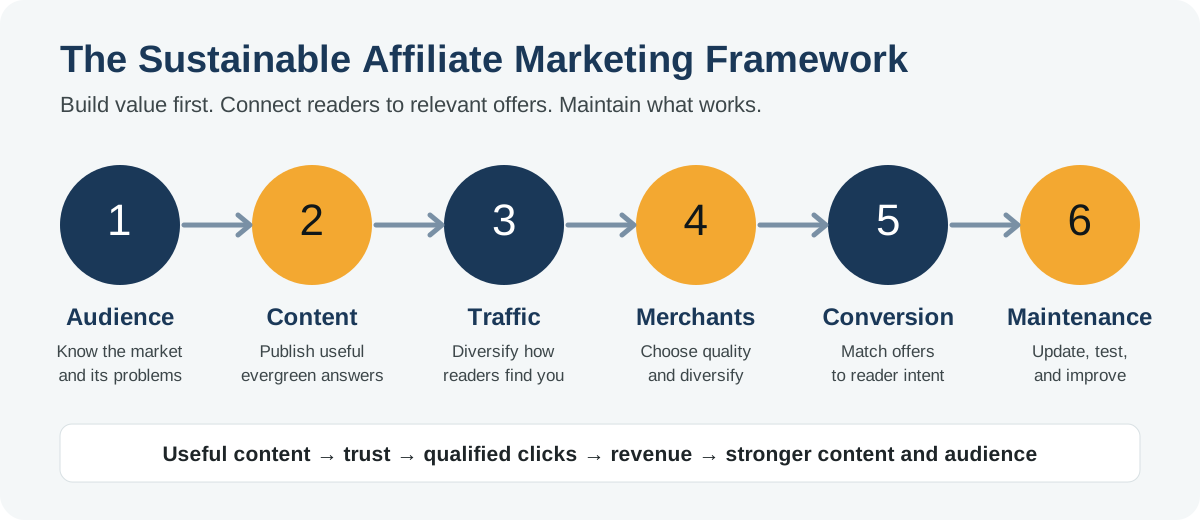
A Simple Sustainable Affiliate Marketing Framework
- Choose a defined market. Select an area with persistent questions, active buyers, and multiple merchants.
- Map the questions. Identify beginner, comparison, purchasing, troubleshooting, and post-purchase questions.
- Build evergreen resources. Create content that can remain valuable for years with periodic updates.
- Add relevant affiliate offers. Match offers to reader intent rather than forcing offers into every article.
- Build multiple traffic sources. Develop search visibility, then gradually build email, direct traffic, referrals, and other channels suited to the niche.
- Measure commercial performance. Track clicks, conversions, earnings per click, revenue, and merchant performance.
- Maintain the library. Update important pages, replace dead links, refresh recommendations, and expand successful content clusters.
That process can be repeated indefinitely.
Frequently Asked Questions About Sustainable Affiliate Marketing
Is affiliate marketing still worth doing?
Affiliate marketing remains a viable online business model when publishers create useful content, attract relevant audiences, and work with reputable merchants. Results vary significantly, and affiliate income is not guaranteed.
Do you need a website for affiliate marketing?
Not every affiliate program requires a website, but owning a website provides greater control over content, search visibility, audience development, and long-term digital assets.
How long does affiliate marketing take to work?
There is no universal timeline. Results depend on competition, content quality, distribution, traffic sources, niche, merchant performance, and publishing consistency. New websites often require substantial time before building meaningful organic visibility.
Can affiliate marketing become passive income?
Affiliate content can continue generating commissions after publication, but successful affiliate businesses generally require ongoing maintenance, updating, link management, and audience development.
What is the best type of affiliate content?
There is no single best format. Useful educational articles, comparisons, buyer guides, tutorials, and product-specific resources serve different stages of the customer journey.
Should every article contain affiliate links?
No. Educational content without commercial links can still attract visitors, establish expertise, build internal linking opportunities, and introduce readers to other useful pages.
Should affiliate marketers promote the highest-paying products?
Not automatically. Product relevance, quality, merchant reputation, conversion rate, customer experience, and audience fit can matter more than the advertised commission percentage.
How many affiliate programs should a website use?
There is no ideal number. The important principle is avoiding unnecessary dependence on a single merchant while keeping recommendations relevant and manageable.
What is the biggest risk in affiliate marketing?
Dependency is one of the largest risks. A business that depends entirely on one search engine, one social platform, one merchant, or one product can be severely affected when that relationship changes.
The Long-Term Advantage Belongs to Useful Websites
Affiliate marketing does not become sustainable because someone finds the perfect product. Products change. Programs change. Platforms change. Search results change.
What lasts longer is usefulness.
A website containing trustworthy guides, clear explanations, thoughtful comparisons, strong internal connections, and genuinely useful answers can adapt when the commercial environment changes.
That is the fundamental advantage of building an affiliate publishing business instead of merely posting affiliate links. Build the audience. Build the information. Build the trust. Then connect readers with products and services that genuinely fit what they are trying to accomplish.
That is how affiliate marketing becomes an asset instead of a temporary campaign.
Topics: affiliate marketing, affiliate business, sustainable affiliate marketing, affiliate income, affiliate websites, affiliate SEO, online income, evergreen content, content marketing, affiliate programs, affiliate links, digital marketing, niche websites, conversion tracking, email marketing, search engine optimization, content strategy.